
A Japan Rail Pass is worth considering when the journeys it covers cost more than the pass and fit within its validity period. It is not automatically the cheapest choice for every visitor. Start with the trips you actually plan to take, then compare the current complete costs.
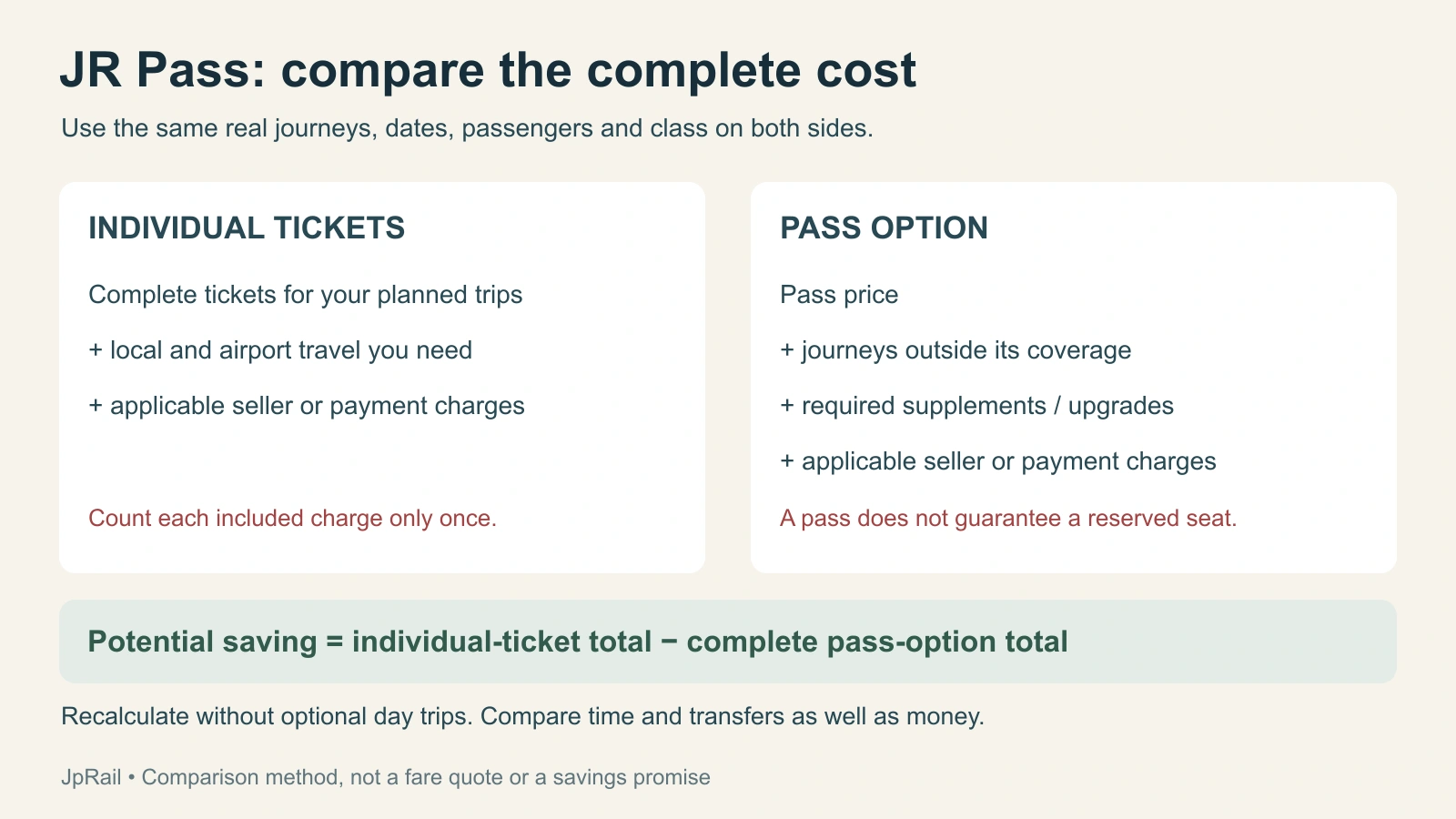
Build an itinerary ledger before pricing a pass
List each intercity leg with its date, exact stations, preferred service and accommodation. Add airport and local travel only where the specific pass genuinely covers them. For every row, mark covered, partly covered or excluded. A map showing a railway in the same region is not sufficient evidence of coverage.
Then obtain current separate-ticket totals for the same itinerary. Compare those with the pass price plus every necessary supplement and excluded leg. Do not count hypothetical side trips as savings unless you actually intend to take them. A pass that encourages extra train travel can increase the total holiday cost once hotels and time are considered.
Use one row per journey and record these fields: travel date; exact stations; passenger category; train and class; complete separate-ticket quote; pass coverage; extra charge; reservation requirement. Keep a source link and the date checked beside each quote. The fare guide explains the components.
Compare the same dates and conditions
The nationwide pass uses consecutive validity days, so days spent sightseeing in one city can use part of that period. Compare your eligible train fares with the current pass price plus excluded travel and required supplements. Check ordinary versus Green Car products and child eligibility. A regional pass can have a different validity pattern or service coverage; do not apply nationwide pass rules to every product carrying the JR name.
Use a break-even calculation you can check
Let the separate-ticket option be the sum of the journeys you would really buy. Let the pass option be the pass price plus non-covered transport, special train supplements and any class upgrades. The financial saving is the separate-ticket total minus the complete pass option. Use current prices in the same currency and retain the dates you checked.
Run a second scenario without optional day trips. If the pass only appears cheaper after adding journeys you may skip, the decision depends on those plans. Also compare the time and transfers required to use covered services. A small apparent saving may disappear in practice if it requires a route that does not suit your schedule.
Nozomi and Mizuho need special attention
The nationwide Japan Rail Pass alone does not cover Nozomi and Mizuho under its standard conditions. Eligible holders can use these services with the separate special Nozomi/Mizuho ticket for the relevant journey. Alternatively, a covered service such as Hikari may suit the route but involve a longer journey or a transfer. Include both the additional cost and travel time in your decision. See Nozomi, Hikari and Kodama compared.
Three useful itinerary comparisons
- Tokyo plus a one-way journey to Kyoto or Osaka: start with individual tickets and compare any pass against that limited amount of long-distance travel.
- Tokyo, Kansai, Hiroshima and a return: more intercity travel makes a pass comparison useful, provided the journeys fit the validity window and train conditions.
- One region with several day trips: compare a relevant regional pass as well as individual fares. Airport and private-railway coverage varies.
These are comparison methods, not a savings promise. Do not rearrange a relaxed holiday into unnecessary long journeys just to use a pass.
Check eligibility, activation and reservation separately
Before purchasing, verify eligibility and any passport or entry-status requirements on the official product page. Check exchange or activation instructions, the validity period and how travel dates fit inside it. Do not assume a ticket seller supports pass reservations merely because it sells the same railway route.
The nationwide Japan Rail Pass alone excludes Nozomi and Mizuho; use with those services requires the specified additional special ticket. Regional products have their own conditions. A pass does not create seat inventory: check reservations for the departures that matter, especially for groups, designated peak periods and baggage needs.
Current nationwide JR Pass price benchmarks
Checked on 11 October 2026: the official JAPAN RAIL PASS price page lists different adult prices for its online sales service and overseas designated agencies. Amounts below are yen; they do not establish availability or a JpRail selling price.
- Ordinary, 7 days: Official online ¥50,000; Overseas designated agency ¥53,000.
- Ordinary, 14 days: Official online ¥80,000; Overseas designated agency ¥84,000.
- Ordinary, 21 days: Official online ¥100,000; Overseas designated agency ¥105,000.
- Green, 7 days: Official online ¥70,000; Overseas designated agency ¥74,000.
- Green, 14 days: Official online ¥110,000; Overseas designated agency ¥116,000.
- Green, 21 days: Official online ¥140,000; Overseas designated agency ¥147,000.
Use the price for the channel and passenger category you will actually buy. Check the official price page for child prices and current conditions; do not assume every agency price is identical to the official online amount.
A worked Tokyo–Kyoto comparison
For one adult, the currently linked SmartEX reference table gives ¥13,650 each way for an Ordinary reserved Hikari/Kodama journey in the regular season. Two separate tickets total ¥27,300, compared with ¥50,000 for the seven-day Ordinary pass through the official online channel. That leaves ¥22,700 of additional covered journeys before the pass reaches the same spend, before any exclusions or supplements. This calculation uses the official SmartEX reference table, dated 1 April 2025 and checked on 11 October 2026. It is a planning example using named products, not a current JpRail quote; recheck your travel dates and terms.
Make the final decision with current prices
Compare the journeys you want, not a generic online claim that a pass always pays for itself. JpRail train search results are separate ticket offers unless explicitly described otherwise; this article does not imply that JpRail sells or activates rail passes. Use the official pass resources for purchase eligibility and current terms, and our ticket buying guide for standalone journeys.
Official planning resources
Editorial review: 10 October 2026. Check the current operator instructions and your issued product before travel.