
Two questions shape almost every shinkansen seat decision: how comfortable is the seat, and do I hold a specific seat assignment. Travellers often treat them as one, then feel surprised at the gate. They are separate axes, and understanding both saves money and prevents disappointment on the platform.
This guide explains what each shinkansen seat class does and does not include, how reserved and unreserved tickets actually behave, and how to match the choice to a real journey. For a broader first-trip overview, start with the first-time shinkansen guide.
Seat Class and Reservation Status Are Two Different Questions
Seat class describes the physical product: Ordinary, Green, or, on a small number of services, GranClass. It affects seat width, spacing and the applicable charges; noise and occupancy vary.
Reservation status describes whether you have been assigned a specific seat. Ordinary reserved and Ordinary unreserved are the same class of seat; the reservation gives an assignment, although physical layouts can differ between train formations.
- Ordinary unreserved: valid for the date and section shown, no seat number, standing possible when cars fill up.
- Ordinary reserved: a seat number for a specific service and car.
- Green reserved: a Green car seat number.
- GranClass reserved: a GranClass seat number, where the service offers it.
So “reserved” is never shorthand for “better seat”, and “unreserved” is never shorthand for “worse seat”.
Ordinary Reserved and Ordinary Unreserved in Practice
What an unreserved ticket really buys
An unreserved ticket is flexibility with a trade-off. It is tied to a valid date and section, and seating is first-come within the unreserved cars. During busy periods you may stand for part or all of the journey. Unreserved tickets also carry restrictions on which services, cars and sections they can be used on, so check the conditions printed on your ticket rather than assuming every train is interchangeable.
Peak Nozomi services on the Tokaido Shinkansen operate as all-reserved at designated peak times, so an unreserved strategy cannot be assumed to work on the busiest days. Check current conditions on the official JR Central Nozomi information page before you rely on flexible boarding.
When reserved seating earns its keep
Reserve when you travel with others and want to sit together, when you need a confirmed seat on a particular departure, or when you are boarding on a peak travel day. Reserve less urgently for a short hop where standing briefly would not matter to you.
Green Car: Comfort as a Measurable Upgrade
Green Car is the premium class available across the main shinkansen network. The practical difference is space: wider seats and more generous pitch, with fewer seats across a typical row. Occupancy and quiet are not guaranteed. It is a genuine comfort upgrade, not a reservation status, and it requires the base fare, applicable limited express charge and Green charge, which may be sold as one bundled total for the relevant class and section.
Green Car makes sense when the journey is long enough for comfort to compound, when you are travelling for business and want to work, or when a special trip justifies the supplement. It makes less sense for a very short segment where you will barely settle in.
Remember that a Green purchase upgrades your seat only. It does not change luggage rules, which are handled separately in the shinkansen luggage guide.
GranClass: Limited Availability and Two Different Products
GranClass is not a network-wide option. It appears on selected trains on the Tohoku, Hokkaido, Hokuriku and Joetsu Shinkansen, and it is not available on Tokaido Shinkansen travel between Tokyo and Kyoto. If your itinerary is Tokyo to Kyoto or Osaka, GranClass is simply not on the menu; compare Ordinary and Green instead.
Where GranClass exists, check what the product actually includes. Some GranClass offerings are service products with attendant service and light meal and drink service; other services have no GranClass attendant, light meals or drink service. The seat is premium in both cases, but the inclusions differ, so read the product description rather than the class name.
See the official JR East GranClass page for current scope and inclusions.
Seat Layout, Power Outlets and Fleet Reality
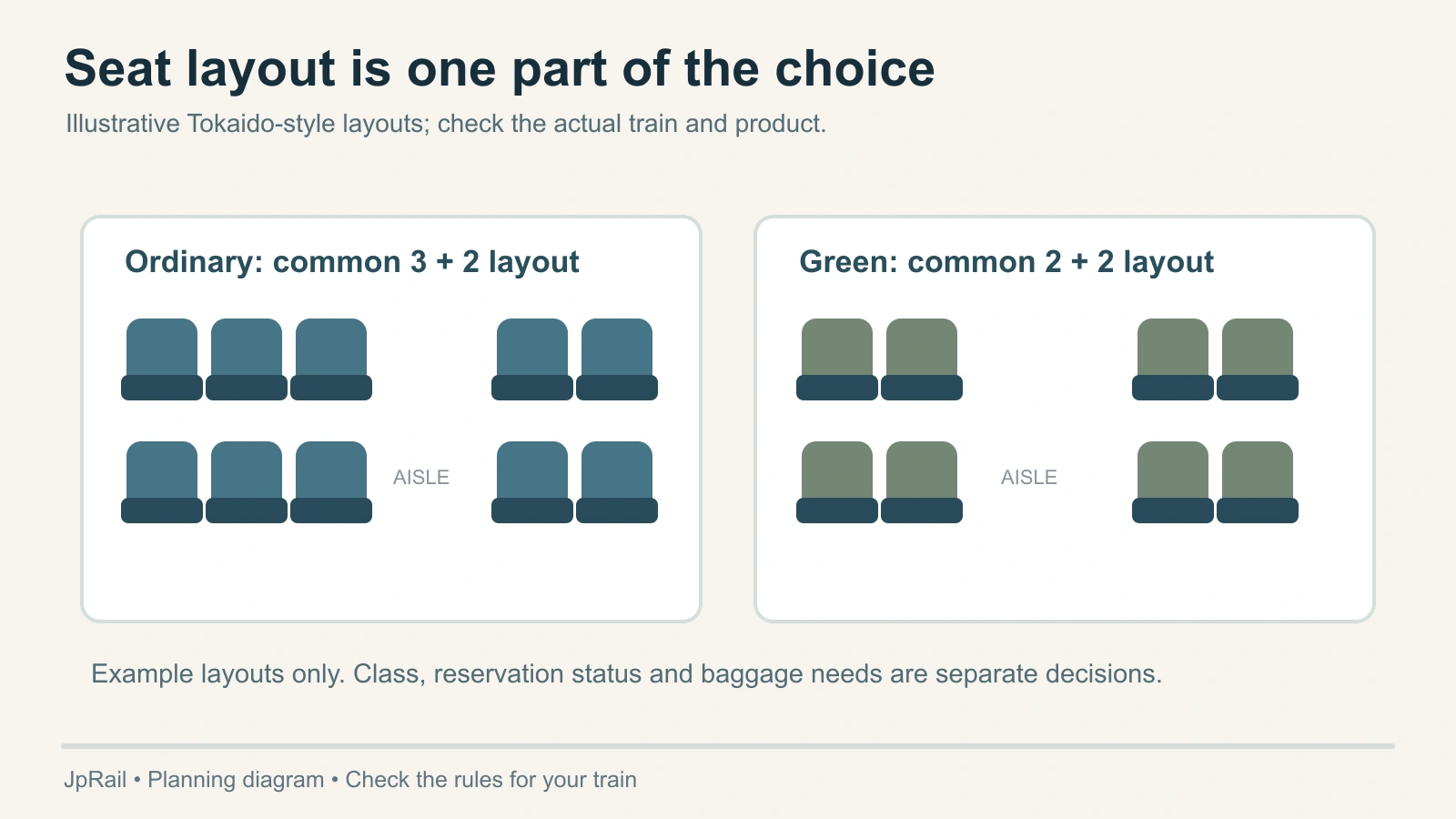
2+3 versus 2+2 is formation-specific
The familiar comparison of a 2+3 arrangement in Ordinary against a 2+2 arrangement in Green comes from Tokaido N700 formations. It is formation-specific and not a universal shinkansen rule. Do not plan around it as though every train follows it; check the seat map shown for your specific service when one is displayed at booking.
Outlets: what is documented versus what is guaranteed
On N700S formations, power outlets are provided at every seat. On N700A formations, outlets in Ordinary are documented at window seats and end rows. These are official configuration facts for specific train types, not a promise about the particular set that turns up on the day. Consult the official JR Central accommodation information, and treat any fleet assumption as provisional.
Finally, a “quiet atmosphere” is a tendency, not a guarantee. Cabins are generally calm, but announcements, families and phone conversations still occur.
Choosing by Trip Scenario
Solo traveller, short segment
Ordinary unreserved is usually rational: you board, sit if a seat is free, and the segment ends quickly. Reserve if having a seat on a specific departure matters. A reservation cannot guarantee arrival time or prevent disruption.
Family with children
Reserve. Adjacency matters when supervising children, and an aisle or window preference is a request, not a confirmed assignment. Plan around the possibility that seats may not be side by side. Practical planning notes are in the shinkansen with children guide.
Laptop work
Reserved seating plus reliable power access is the combination to aim for. If outlets are essential, verify the train type and seat position documented for that formation instead of assuming an outlet will be within reach.
Comfort-oriented long trip
Green is the sensible premium here. Compare the cost by adding the actual upgrade difference for each adult and child rather than judging a single price in isolation. For general fare structure context, see shinkansen ticket prices, and for service types, see Nozomi, Hikari and Kodama compared.
Views, Luggage and Children: Separate Decisions
For Mount Fuji, the illustrative guidance is the right-hand side heading westbound from Tokyo and the reverse on the return. These are typical conditions shaped by weather, season and time of day, and they do not correspond to a guaranteed seat letter. Book the side you prefer, then accept the view as a bonus.
Eligibility for oversized luggage seating is a separate requirement from any premium upgrade. Buying Green does not by itself satisfy luggage rules, and luggage arrangements should be confirmed alongside, not instead of, seat selection.
Children's pricing needs care. Reduced fare rules for children generally apply to base and limited express fares, but premium supplements for Green or GranClass are not simply half of the adult total. Check the official adult and child fare rules and the relevant combination conditions on the JR Central fare combination page before budgeting for a family upgrade.
Before You Board: What to Check on Your Issued Tickets
Paying for a request is not the same as holding an issued ticket, and a seating preference is not a confirmed seat. Work through this checklist once your tickets are in hand:
- Date and section on each ticket match your intended journey.
- Train service and car number are printed where a reservation exists.
- Seat numbers are present for every traveller you expect to seat together.
- Class and reservation status read what you think you bought: Ordinary or Green, reserved or unreserved.
- Base fare and supplement are both accounted for on the correct tickets.
- Child and adult tickets are correctly issued for each traveller.
- Luggage arrangements are confirmed separately if you travel with large items.
Arrive with a buffer. A 30-minute station arrival is editorial advice for unfamiliar stations, not a universal minimum connection, and never a substitute for checking your own itinerary.
Common Mistakes and How to Handle Exceptions
- Assuming “reserved” means Green. It means a seat number. Ask your seller about correcting the class before you board.
- Planning on 2+3 versus 2+2 everywhere. Confirm the formation for your service, or plan for either outcome.
- Expecting side-by-side seats from a preference request. If the issued tickets show separated seats, ask staff before departure rather than rearranging passengers onboard.
- Assuming unreserved will always have seats. If unreserved cars are full, you stand; if that is unacceptable, choose a reserved option for that date.
- Looking for GranClass on Tokyo–Kyoto. It is not offered there. Compare Ordinary and Green instead.
- Treating the Fuji-side rule as a seat guarantee. Weather and timing dominate. Pick a side, then let the view be optional.
- Applying fixed refund expectations. Refund and change conditions vary by ticket type and timing, so check the conditions on your issued tickets rather than assuming a universal deadline.
Whenever something conflicts with your expectation, contact the seller before departure. Station staff can help with gate or platform problems, but may be unable to amend a third-party booking. Once onboard, options narrow quickly.
Editorial note: the official references linked above were checked on 10 October 2026.
Supreme Class cabins: a separate, limited product
From 1 October 2026, selected Tokaido and Sanyo Shinkansen departures offer Supreme Class cabins. These are distinct from GranClass: their existence does not mean that GranClass operates between Tokyo and Kyoto. Compare Ordinary and Green for broadly available choices, and check the exact train and sales channel if considering a private cabin.
SmartEX specifies one-person and up-to-two-person cabin options with product-specific booking and accompanying-passenger conditions. Its Supreme Class product uses an IC card or QR Ticket rather than paper-ticket collection. These are SmartEX product rules, not a promise that JpRail sells the cabin or uses the same process. Verify the current official Supreme Class conditions before purchase.