
What stored value normally covers
Suica, PASMO and ICOCA can simplify supported local journeys and small purchases, but a balance on the card is not a universal entitlement to long-distance rail travel. Limited-express charges, reserved seating and Shinkansen travel generally require an additional ticket or a specific supported reservation product.
A linked reservation is a separate product
Some ticketing systems let you register a compatible IC card against a reservation. Each passenger may need their own correctly linked card. Follow the instructions from the issuer; a JpRail order should not be assumed to support linking unless the issued instructions explicitly say so. Adding money to the card does not link a reservation.
Transferring from local rail
When local travel and the Shinkansen use different ticket methods, a transfer gate may need both. Read the issued instructions before presenting an IC card and a QR code in an arbitrary order. Ask staff if the gate rejects the combination, and keep track of the card used to enter the local network.
Coverage areas and balance
Many IC cards are interoperable across supported networks, but a single continuous stored-value journey generally cannot cross separate IC-card areas. Some stations and transport services do not accept IC cards. Keep an alternative payment method and enough time to buy a ticket for a regional connection.
Before leaving Japan
A physical card, mobile card and any rail reservation can have different refund or balance rules. Resolve any incomplete local-rail entry before departure. Do not discard or reset a card that is still linked to an upcoming journey without checking how it affects boarding.
Three things that are easy to confuse
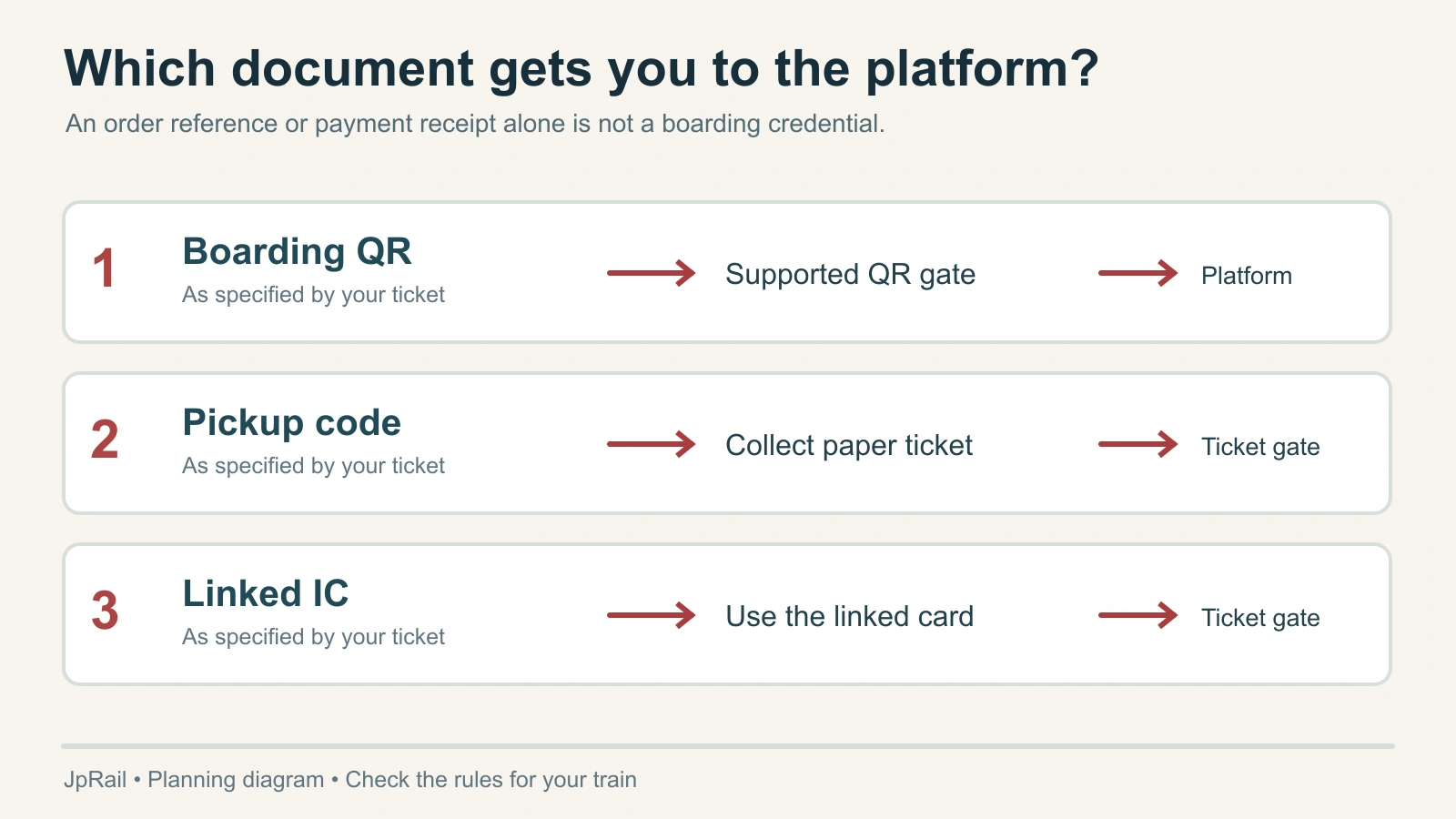
Stored value is money for eligible transport or purchases. A linked reservation is a separately purchased train entitlement associated with a compatible card. A boarding QR or paper ticket is another way of presenting the entitlement. Adding money to Suica, PASMO or ICOCA does not turn stored value into a reserved Shinkansen booking.
Before travel, identify what your actual product uses. If the seller issued a boarding QR, do not assume you can substitute your phone wallet. If it expressly supports IC linking, check the assigned card for each passenger and confirm the link is complete. A confirmation email that names a card is more useful than an assumption based on owning one.
Prepare a group one passenger at a time
Make a private checklist with one row for each fare-paying traveller: name or family label, boarding method, assigned card or document and seat if reserved. Follow the issuer's child-card compatibility instructions for child fares. Do not assign one physical card to several people for simultaneous travel.
For a family sharing a booking, distribute the correct boarding documents before the gate. Keep the adult responsible for a younger child close enough to help without holding up the lane. A baby travelling under a valid free-travel condition should not be assigned an invented ticket or duplicate code; use the actual passenger instructions for the product.
A mixed local-train and Shinkansen journey
Imagine leaving Shibuya using a stored-value card and transferring to the Shinkansen at Shinagawa with an issued QR. The local journey and the long-distance entitlement still need correct handling. Keep the original card available and read the instructions for that combination. There is no safe universal rule to scan every QR first or tap every card first.
If a gate rejects the combination, move to the staffed area and explain the station where you entered, the card used and the ticket format for the next leg. Do not tap several different cards until one works. Doing so can complicate entry records and make the problem harder to diagnose.
Phone replacement, lost cards and unfinished trips
Before changing phones, removing a mobile card or replacing a physical card, check whether any future reservation is linked to that card identity. Follow the issuer's process for changing the association; a new wallet card is not automatically the old linked card.
If a card is lost or the phone cannot present it, contact the booking issuer and station staff early. Keep the booking reference accessible separately from the affected device. For an incomplete local journey, ask the railway to resolve the entry record before continuing. Ticket replacement, balance recovery and reservation changes are different procedures and may have different conditions.
Know which account pays for which leg
A card linked to a reservation can act as the boarding identifier without its stored balance paying the Shinkansen fare. For example, SmartEX describes payment through the reservation's payment method while a registered transit IC card can be used to board. This is different from topping up the card for eligible local travel.
Before a mixed journey, check the Shinkansen booking payment and the requirements for the local leg separately. If one succeeds and the other fails, adding money or repeating payment without diagnosing the affected leg may not solve the problem. Other operator products can work differently, so follow the named product rather than assuming every IC-based service uses the same payment flow.
SmartEX: boarding with an IC card
Official planning resources
Editorial review: 10 October 2026. Check the current operator instructions and your issued product before travel.