
Finish sightseeing before the station deadline
Arrange luggage collection and a dependable route back to Kyoto Station before selecting your departure. A bus from a distant temple district can be affected by road traffic and queues. Leave time to reach the high-speed gates and correct car, especially if paper-ticket collection is required. A cheaper restricted ticket is less useful if it depends on the shortest possible sightseeing-to-platform connection.
Choose the Tokyo end for the onward trip
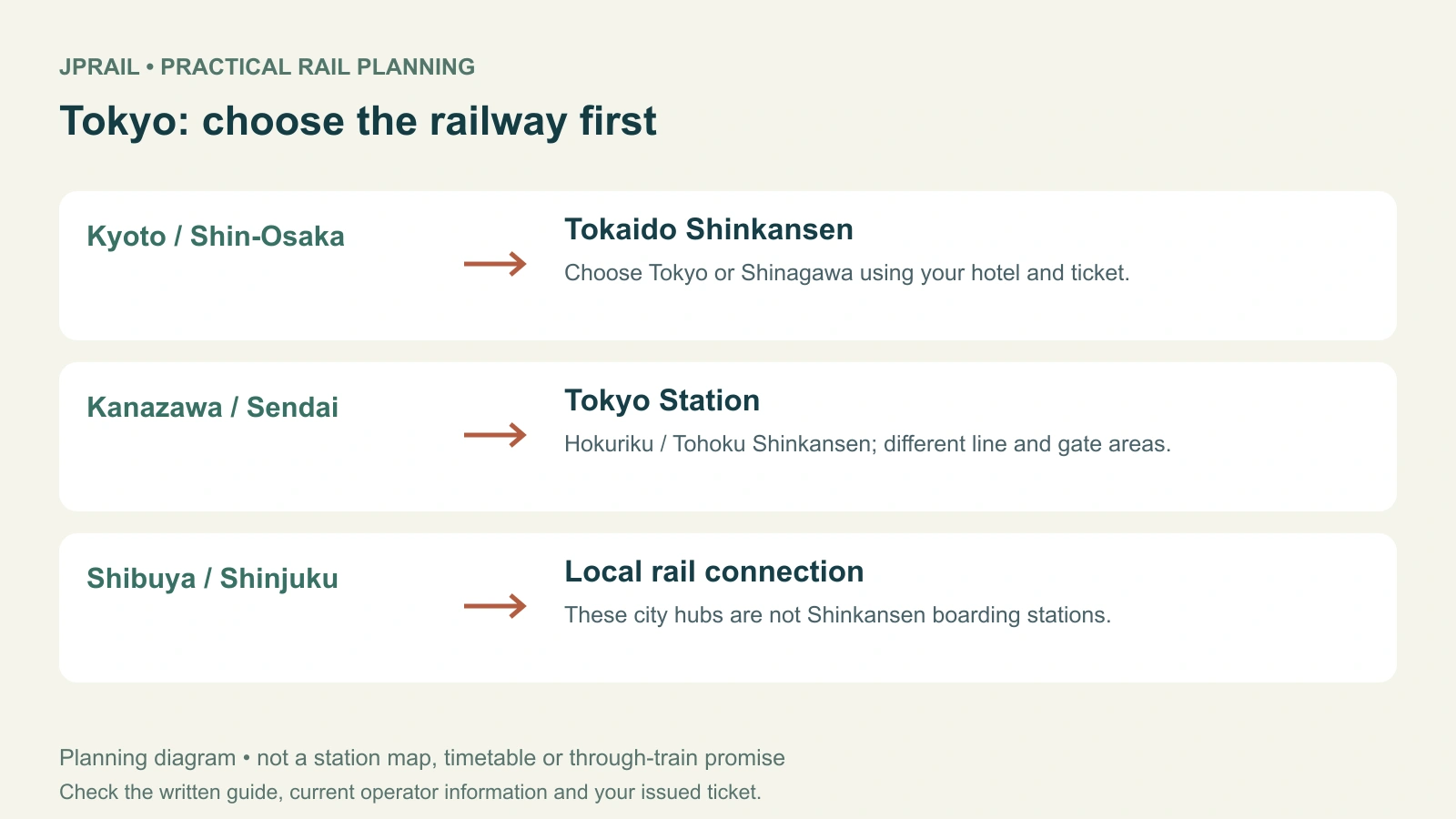
Shinagawa may suit south Tokyo and some Haneda connections; Tokyo Station may suit another hotel or onward northern Shinkansen. Use the arrival station actually covered by your ticket. For a flight, add airport transport, terminal access, airline check-in and disruption margin to the intercity ride. A morning train duration is not proof that a particular flight connection is safe.
Travel time and train choice
Plan for about 2 hours 10 minutes to 3 hours 40 minutes. This is an approximate guide across different service patterns, not a timetable or a guaranteed duration. This journey uses the Tokaido and/or Sanyo Shinkansen corridor. Nozomi makes fewer stops on the sections it serves; Hikari, Kodama and Sanyo services have different stopping patterns. Direct and connecting options vary by date. The search result, rather than this guide, determines which trains you can book.
Leaving Kyoto
Kyoto Station sits south of many of the best-known historic districts. The north side faces Kyoto Tower and the main city bus area; the Hachijo side is convenient for Shinkansen access. Choose your exit using the hotel address, not just the nearest gate.
Arriving in Tokyo
Tokyo Station has two very different sides: Marunouchi faces the Imperial Palace area; Yaesu is convenient for many Tokaido Shinkansen entrances. Shinagawa is another useful Tokaido stop, particularly for south Tokyo. Check the station on your ticket before setting out from your hotel.
Which seat should you book?
Ordinary reserved seating is a practical choice for most trips. Green Car offers more space where available. GranClass is not offered on this Tokaido, Sanyo or Kyushu route. Unreserved products, when offered, do not guarantee a seat and may have date-specific restrictions. Book the correct adult and child counts, then compare the total for your whole party. Requests for neighbouring, window or aisle seats remain subject to availability until issuance.
Luggage and connections
Measure each suitcase including wheels and handles. On the Tokaido, Sanyo and Kyushu Shinkansen, a bag whose length, width and height total more than 160 cm and up to 250 cm normally needs the appropriate oversized-baggage reservation. Choose an eligible reserved product and request the space during booking; an ordinary seat preference alone is not a luggage reservation. Items above 250 cm are not permitted under the standard allowance.
How to book this route
Open Search trains on this page. The planner starts with Kyoto and Tokyo; choose your travel date and passenger numbers, compare departures, and select a fare. Check your contact email carefully so you can receive ticketing instructions. Prices can vary by train, class, date and availability, and the final order total is shown before payment.
Before you board
Check the issued ticket for the exact station, date, departure time, train, car and seat. A payment confirmation is not a boarding document. Follow the ticket-specific QR, collection or gate instructions. At an unfamiliar station, allow around 30 minutes before departure, with more time for an airport connection or a large group. All train times are local Japan time.
Changes and missed departures
Review the fare conditions before paying, especially when connecting from a flight or another independently booked service. Request any change or refund through your secure order as early as possible. Eligibility, fees and deadlines depend on the issued product and its status; do not assume that a missed reserved train can be used on any later service.