
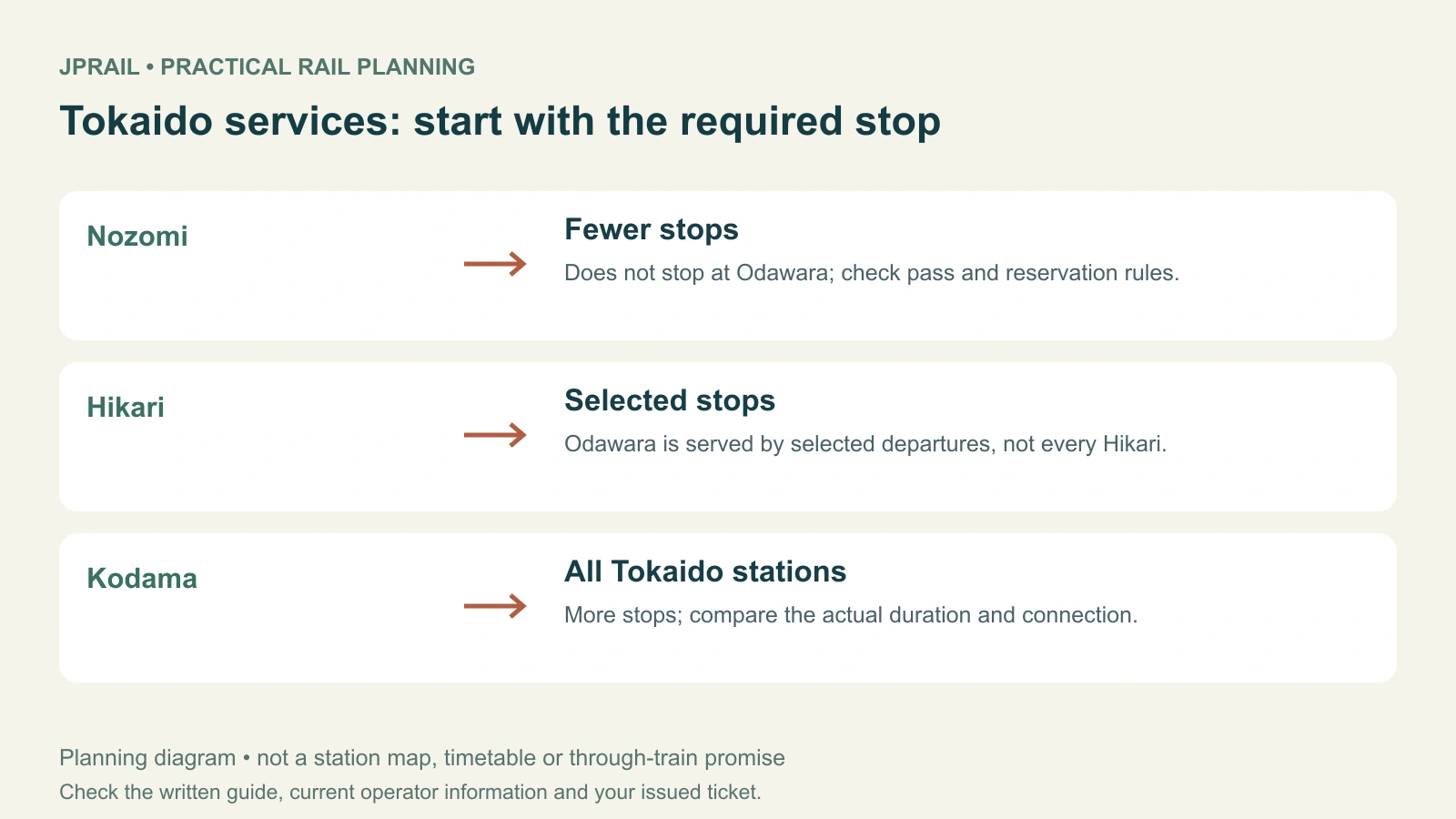
Nozomi, Hikari and Kodama are service names on the Tokaido Shinkansen. Nozomi usually makes fewer stops, Hikari serves more intermediate stations, and Kodama stops at every station on its operating section. Choose a service that calls at your actual destination before comparing speed.
Nozomi for the main city pairs
Nozomi is usually the fastest option between the major Tokaido cities, including Tokyo, Nagoya, Kyoto and Shin-Osaka. Some services continue onto the Sanyo Shinkansen. A train may stop at several major cities without serving smaller gateways such as Odawara. For a specific journey, compare the departure and arrival times shown for your date rather than using a single duration for every Nozomi.
Hikari for intermediate stops and pass planning
Hikari can serve useful intermediate stations and may suit travellers using a nationwide Japan Rail Pass without the special Nozomi supplement. Stopping patterns differ between departures, so a Hikari name alone does not prove that it calls at Odawara or another particular station. Check the full stop list before committing to an onward local connection.
Kodama for smaller Shinkansen stations
Kodama is useful when your destination is a station skipped by faster services. It generally takes longer over a large distance and may wait at stations while faster trains pass. For a short section to an appropriate gateway, it can still be straightforward. The Tokyo to Odawara guide illustrates why station coverage can matter more than the fastest service name.
Compare the actual ticket, not just the train name
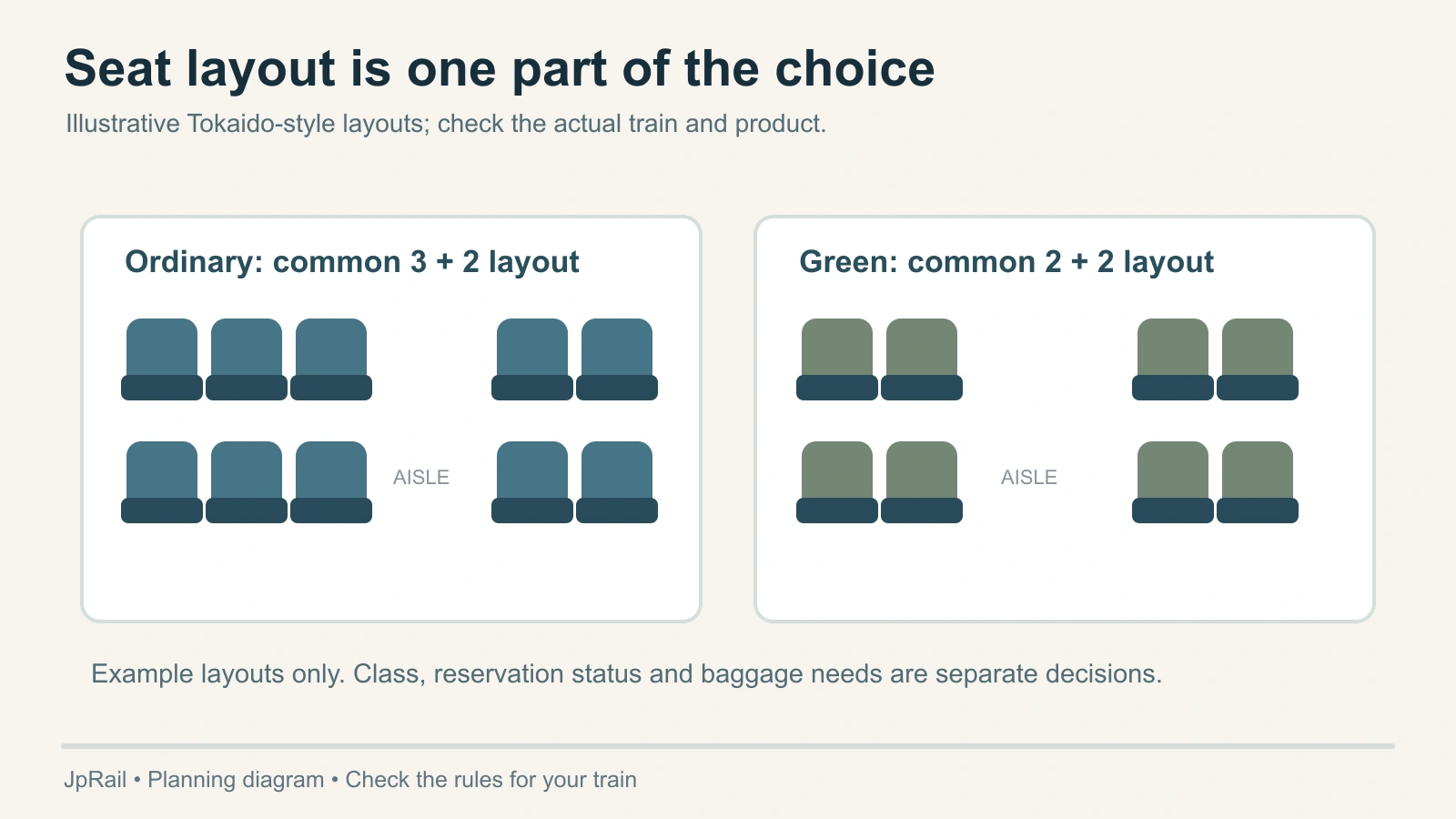
Ordinary, Green Car, reserved and non-reserved options depend on the departure and product. A train name does not guarantee a particular cabin, luggage arrangement or flexible ticket. GranClass is not a Tokaido Shinkansen cabin. Check the seat guide and review the full fare and rules before paying.
Peak-period Nozomi reservations
JR Central and JR West operate Nozomi with all seats reserved during designated major peak periods. Check the operator’s published dates for your trip; do not assume a non-reserved product provides a seat on those departures. Hikari and Kodama have their own inventory and can also be busy. Travelling earlier in the day or adjusting the date may be more practical than relying on last-minute availability.
A quick decision sequence
- Confirm that the train stops at both stations you need.
- Compare the complete journey, including transfers and local travel.
- Check any pass coverage or required supplement.
- Choose an available seat and compatible luggage arrangement.
- Review the ticket’s change terms and final passenger total.
For a first trip, combine the corridor map with the pass comparison. The fastest train is useful only if it fits the rest of your journey.
Start with your stop, then compare the service
For Tokyo, Kyoto and Shin-Osaka, compare the actual departures that serve both your origin and destination. Nozomi makes fewer stops, Hikari follows selected stopping patterns, and Kodama serves every station on the Tokaido line. These are service patterns, not different seat classes or separate routes between entirely different cities.
For a smaller station such as Odawara, do not choose a train purely because its category is faster. Check whether that specific departure stops there. Hikari stops vary, and a service that passes your destination cannot be made suitable by buying a more expensive seat. Check the timetable first, then the fare and accommodation.
Direct slower train or faster train with a change?
Compare the whole journey, including the wait at the transfer station, walking between platforms and the risk of missing the connection. A direct Kodama can be an easier choice than a nominally faster combination for a family with a stroller. An experienced traveller with light bags may prefer the connecting alternative if the timetable supports it.
On a comparison sheet, write the departure, arrival and every required change. If the itinerary includes two trains, confirm which tickets and reservations apply to each. Do not infer that a ticket for one named train authorizes any faster train that happens to arrive first.
Read the departure board using three identifiers
Use the service name and number, the departure time and the stopping pattern. The final destination on the board may be beyond your own stop. A train heading to Hakata can still be relevant for Kyoto, but only if it is the departure on your ticket and stops where you need.
Once the platform is confirmed, locate the car marker corresponding to your issued seat. Service category does not decide whether your ticket is Ordinary or Green, and “reserved” is a seat-assignment status. Check the car and class on the issued document rather than joining any queue with the same train name.
Peak-period and pass checks before relying on flexibility
During designated peak periods, Nozomi operates with all seats reserved. Do not plan around an ordinary unreserved-car strategy on those dates; read the current operator guidance, including any conditional standing arrangements. A holiday label in an old article is not a substitute for the announced dates for your journey.
If using the nationwide Japan Rail Pass, account for the additional special ticket required for Nozomi and Mizuho, or compare eligible alternatives under the pass conditions. Check the final arrival time and changes, not only the train name. If your intended service is unavailable, review the next suitable departure before accepting an itinerary that stops short of your destination.
Official planning resources
- JR Central: ticket types and fares
- JR Central: designated Nozomi peak periods
- JAPAN RAIL PASS: official coverage and conditions
Editorial review: 10 October 2026. Check the current operator instructions and your issued product before travel.